
Please note: Reservations are required; walk-ins cannot be accommodated.
Please note: Reservations are required.
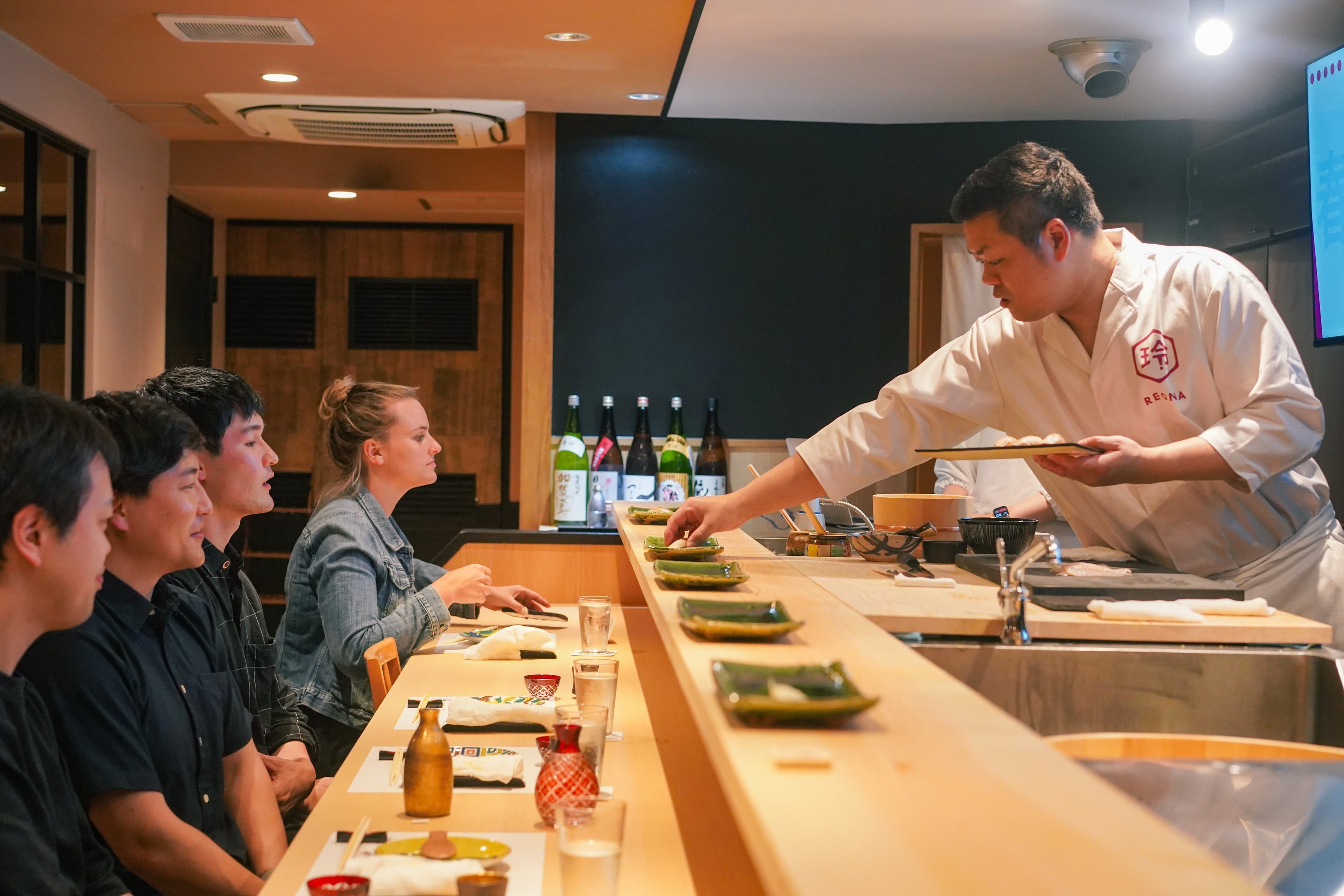

Many people visiting Tokyo want to eat great sushi at least once during their trip.
And while searching online, many visitors come across the word “Omakase.” At the same time, many people probably feel nervous too.
“What kind of food will come out?” “The rules seem strict, will I fit in?” “What if nobody speaks English?”
This article is written for people looking for an English friendly omakase experience in Tokyo, people introducing Japan to overseas guests, and people who want to understand sushi culture more deeply instead of simply eating sushi.
At REONA Sushi Tokyo, a lot of international guests visit us with exactly these concerns.And after the meal, most guests tell us the same thing.
“I was nervous before coming, but I’m really glad we came.”

In this article, I would like to explain why so many guests feel that way after visiting us, and how a sushi experience in Tokyo can become more than just a meal and turn into a lasting memory.
For Japanese people, omakase is something familiar, even if it still feels special.For international visitors, though, it is often unfamiliar.
The first barrier is language.One of the best parts of sitting at a sushi counter is being able to communicate directly with the sushi chef.

But in reality, there are not many sushi chefs in Tokyo who can comfortably speak English. Even if they can speak some English, most chefs are busy preparing food and do not really have enough time to communicate deeply with travelers during service.
It is even said that less than 7% of Japanese people can speak English at a practical level.
That is how difficult it can be for foreign visitors to communicate with sushi chefs while enjoying omakase in Tokyo. Reference: Nikkei “Only 7% of Japanese People Speak Practical English”
One thing guests often tell us is that they could not even make a reservation in the first place because English was not available. The guest only speaks English. The restaurant staff only speak Japanese.
Even the reservation website is only written in Japanese. This becomes even more difficult for guests with allergies. They want to explain their dietary restrictions properly, but the language barrier becomes too high, and in some cases they simply give up.
One guest once told us that they contacted many omakase restaurants in Tokyo asking whether allergy accommodations were possible, but REONA was the only restaurant that replied. That is how high the barrier can feel for international visitors.
Another major concern is the anxiety of not being able to choose.

At most restaurants, guests choose what they want to eat themselves.But in omakase, those decisions are left entirely to the chef.This style is built on trust, which can feel intimidating for first time visitors.
Omakase is very normal in Japan, and it has slowly become more common overseas as well, but it is still not a familiar dining style for many people.Some guests also come from cultures where eating raw fish is uncommon in the first place, so they have no idea what kind of food will appear.
I still remember an older guest from Ecuador who told us it was her first time eating sushi in his life.At first, she looked very nervous while eating.
Another common concern is sushi etiquette.
Many people believe there is a “correct” way to eat sushi. “How should I dip the sushi into soy sauce?” “Is it okay to eat sushi with my hands?” “Is taking photos rude?”
Many high end sushi restaurants in Japan are also extremely quiet. Some guests become so worried about whether they are behaving correctly, whether they are disturbing the atmosphere, or whether they are accidentally being rude, that they cannot fully relax and enjoy the food.

In fact, many guests who visit REONA tell us they had uncomfortable or awkward omakase experiences at other restaurants before coming to us.
Another important issue is something many people overlook. A lack of understanding about the experience itself. Sushi may look simple, but behind it are preparation techniques, culture, and craftsmanship.
Without explanation, guests often leave feeling:
“It tasted good, but I didn’t really understand the difference.”
One sushi we especially feel needs explanation is kohada.Visually, it does not look very impressive to many foreign guests.But once we explain that it is a traditional Edomae sushi fish, that it is rarely eaten outside sushi restaurants, and that careful preparation allows guests to enjoy the fish without noticing the many small bones, the experience changes completely.
A simple looking piece suddenly becomes something memorable.

Because of all these reasons, omakase can feel difficult for many travelers, and what should have been a deep cultural experience sometimes becomes simply “an expensive meal I did not fully understand.”
At REONA Sushi Tokyo, we believe guests can relax much more when they understand what is happening in front of them. We do not think explaining sushi is something special. For us, explanation is what completes the experience.

Every movement at the counter has a reason.
How the fish is handled. How the knife is used. The speed of shaping the sushi.
None of these movements happen randomly.
We explain these things naturally during the course, so guests can enjoy not only the taste, but also the process happening right in front of them. We want guests to feel like they are learning about sushi while eating it.
Creating a relaxed atmosphere is also very important to us. Rather than creating the tense atmosphere that some luxury sushi restaurants are known for, we want guests to feel comfortable asking questions and having conversations. Because of that, our navigators focus less on giving perfect textbook explanations and more on communicating naturally with guests.
We try to speak in a more natural and friendly way instead of sounding too formal. Instead, we prefer asking questions, starting conversations, and creating a warm atmosphere while still maintaining professional hospitality.
These are some of the comments guests often share with us after the meal.
“This was completely different from any sushi I’ve had before.” “I finally feel like I understand sushi.” “I don’t think I can eat ordinary sushi any more.” “The explanations were really interesting.” “The atmosphere felt warm and welcoming.”
That last comment is especially meaningful for us.That comment makes us happy because it means guests enjoyed more than just the food itself.We want guests to leave feeling that they experienced something more than just a good sushi meal.
REONA Sushi Tokyo is located in the Kanda and Ochanomizu area.
It may not be one of Tokyo’s famous tourist destinations, but personally, I believe this area shows something very real about Tokyo.Many people imagine Tokyo as a huge modern city filled with bright lights and famous attractions.But Kanda and Ochanomizu feel different.It is an area where ordinary Japanese people living in Tokyo spend their normal daily lives. There is something authentic hidden inside everyday life here. That is one of the defining characteristics of Kanda.
Long established restaurants, specialty shops, and old bookstores have quietly existed here for generations.
In fact, near REONA there is even a sushi restaurant founded in 1702 that has continued for more than 320 years. This area still carries traces of old Edo period Tokyo. This environment is also very important for sushi itself. REONA’s techniques are based on the traditions of a respected sushi restaurant in Kanda called Hishitani.
There, reliability and careful work have always been valued more than flashy presentation. Things like understanding the condition of the fish, knowing when not to overwork ingredients, and balancing the rice with the fish properly all matter a lot.
At first glance, these things may seem subtle, but together they create a major difference. We also believe it is important not to over dramatize Japanese culture for tourists. Making things easy to understand and losing authenticity are not the same thing. Our goal is to offer an experience connected to real Tokyo sushi culture while still making it approachable for international guests.
That is the approach we value at REONA.

Even at good sushi restaurants, the experience can feel completely different depending on the atmosphere and communication. If guests spend the whole meal feeling nervous, it becomes hard to fully enjoy the experience.
We believe sushi becomes much more enjoyable when guests can relax, ask questions, and understand what they are eating. We want first time visitors to feel comfortable asking questions and enjoying sushi without feeling nervous. If you are looking for more than simply delicious sushi in Tokyo, we would be happy to welcome you.
Your impression of sushi may change after visiting us.