
Please note: Reservations are required; walk-ins cannot be accommodated.
Please note: Reservations are required.
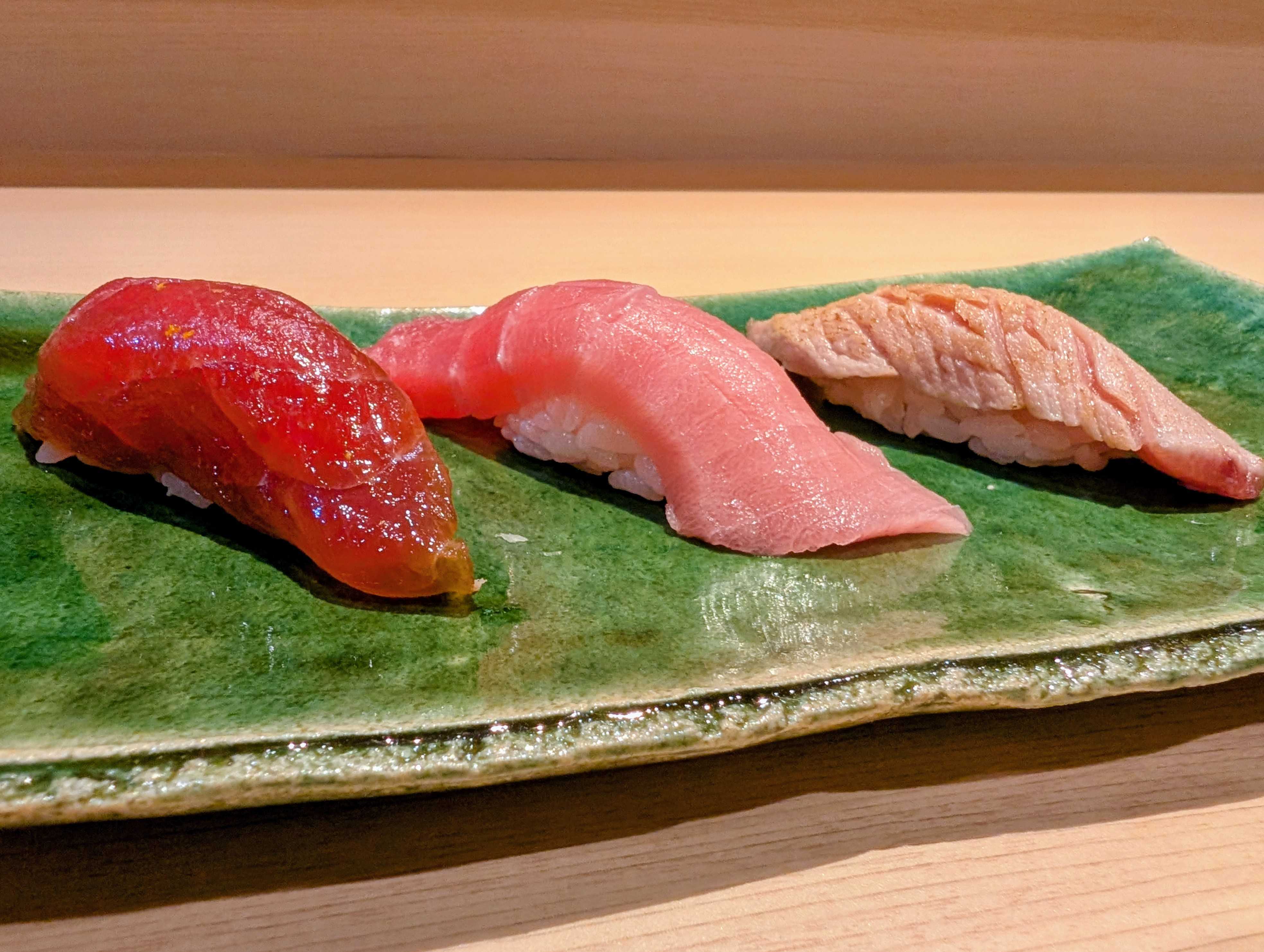

You like maguro, don’t you? Tuna is one of the most popular sushi toppings in Japan and around the world.
When people think of its appeal, many imagine the fat of otoro first. Of course, the melting texture of high-quality fatty tuna is a major part of its charm.
But that is not the whole story. Akami, chutoro, and otoro each have their own appeal. There are also many Edomae sushi techniques used to bring out those qualities.
I trained in sushi in Osaka, Ginza, and Aoyama, and today I serve Omakase every day at REONA Sushi Tokyo. While serving maguro at the counter, I have often wanted guests to understand what makes each part of tuna different, and what kind of sushi work brings out its flavor. That is what I will explain here.
Today, maguro is one of the representative toppings of high-end sushi. But it was not always treated as such a highly valued fish.
Tuna has been caught near Japan for a long time. In the days before reliable refrigeration, however, it was also a difficult fish to handle because its quality declined quickly. The fatty parts were especially perishable, and the toro that is so expensive today was once sometimes discarded.
What changed its reputation was the work of Edomae sushi.
Edomae sushi developed as food for ordinary people in Tokyo. In an age without modern refrigeration, fish could not simply be served raw. Chefs needed ways to preserve it and draw out its flavor.
One representative technique was zuke.
Zuke means marinating lean tuna in soy sauce. By soaking akami in soy sauce, chefs could improve preservation while also allowing the umami of soy sauce to enter the tuna. It began as a practical preservation method, but it also became a way to deepen the flavor of maguro.
The spread of maguro’s popularity is closely tied to this development of Edomae sushi.
We sushi chefs have continued to think about how to preserve tuna, how to cut it, and how to serve each part. Through that accumulated work, maguro became a topping that symbolizes Tokyo’s sushi culture.
Tuna is a large fish.
As chefs, we think about tuna in fairly detailed sections as shown in the image below. The amount of fat, firmness, aroma, and texture all differ depending on the part. The way we cut and serve it changes as well.

That said, if a sushi restaurant divides everything too finely for guests, it can become difficult to understand. So most sushi restaurants mainly serve maguro in three broad categories: akami, chutoro, and otoro.
Here are the main cuts and preparations worth knowing if you want to enjoy authentic maguro sushi in Japan.
Otoro is the part of tuna with especially high fat content.
It is known as a very expensive cut, but that is not only because it is popular. The parts that can be served as otoro are only found in sufficient quantity in certain tuna, such as Hon Maguro and Minami Maguro. Even within one fish, the amount is limited.
Take a look at the image below. You’ll see just how little of a giant tuna qualifies as Otoro. Only a tiny section from the largest tuna makes the cut for this grade.

The appeal of otoro is its rich fat and melting texture. When you place it in your mouth, the temperature of the fish slowly rises, the fat begins to loosen, and the aroma and sweetness of maguro spread out.
At the same time, because it is so fatty, there is a little caution in how to enjoy it. If you eat many pieces in a row, it can start to feel heavy. I think otoro is best enjoyed as a memorable part of a course, rather than something to eat in large quantity.
Raw otoro is the clearest way to taste the fat and texture of otoro itself.
Good otoro is not simply strong in fat. The fat should have sweetness, the fibers of the fish should feel smooth, and it should not become too heavy when eaten with Shari (sushi rice).
If the fat is too strong, only the impression of fat remains in the mouth, rather than the flavor of tuna. Good otoro has a clean finish, and the aroma of maguro remains after you finish eating.

One way to enjoy otoro that I really want people to know is Aburi (light searing) otoro.
Aburi otoro may look bold at first. In reality, it requires very delicate heat control.
The important point is not to cook the inside. Only the surface is lightly seared, leaving the silky texture inside while allowing a little of the fat to melt. If too much heat is applied, the flesh becomes firm and the smoothness of otoro is lost.
Because otoro is rich in fat, a little heat brings out its aroma. Searing brings the sweetness of the fat forward, giving the same otoro a different impression from raw otoro.
I believe the best way to serve high-quality otoro is often as aburi.
Akami is the cut where the flavor of tuna itself is easiest to understand.
Because a large amount can be taken from one tuna, it is relatively easier to obtain than otoro or chutoro.

But that does not mean it should be treated lightly. If anything, akami shows the quality of the tuna and the skill of the chef very clearly.
There is no strong fat to hide behind. The condition of the fish, the cut, the temperature, and the balance with shari all appear directly in the flavor. I think akami is the part where you can most clearly feel the quality of a sushi restaurant.
Good akami is clean but not thin in flavor. It has a moist texture, and the more you chew, the more the umami of tuna spreads.
Many serious sushi lovers prefer akami to otoro. I also remember good akami very strongly when I encounter it. It is not flashy, but it feels like touching the core of the fish called maguro.
Raw akami is sushi that lets you taste the umami of tuna directly.
High-quality akami has a beautiful color and a moist texture. When you place it in your mouth, it first feels clean, but the umami comes out as you chew.
It does not have the immediate impact of otoro. But I think the more someone has eaten sushi, the easier it becomes to recognize the value of good akami.
Akami is the cut for enjoying the flavor of the fish itself, not the fat of maguro.

The preparation that best shows the Edomae character of akami is zuke.
Zuke is the work of marinating akami in soy sauce. It was originally created as a way to preserve tuna, which spoils easily. In modern Edomae sushi, however, it is used not only for preservation, but also as an important technique for adjusting flavor.
Akami prepared as zuke becomes deeper in color, and the texture on the tongue becomes slightly smoother. When the umami of soy sauce enters the fish, it does not simply make the flavor stronger. It feels more like the flavor gains depth.
But it is not enough to simply soak tuna in soy sauce. If the marinating time is too long, the original flavor of the maguro is hidden. If it is too short, it does not come together as zuke. The chef has to judge the condition of the fish and decide how long to marinate it. That judgment is very difficult.
Zuke is a preparation that shows the thinking of Edomae sushi very clearly. If you compare raw akami and zuke, it becomes easier to feel how the same maguro changes when the chef’s work is added.
Tekka maki is a nori roll made with akami.
It is a simple roll, but many people love it. When the flavor of akami and the aroma of nori come together, it creates a kind of deliciousness that is different from nigiri.
Good nori has a strong aroma. When it meets the umami of akami, the aroma of fish and seaweed overlaps in the mouth. Parts of akami that are difficult to use for nigiri can also be used in rolls, making them delicious without waste.
Tekka maki is not flashy sushi, but it is a very good piece for understanding the compatibility of maguro and nori.
Chutoro is the cut between akami and otoro.
It is not as fatty as otoro, but it has more lingering fat than akami. In other words, it lets you enjoy both the umami of maguro and the sweetness of fat in good balance.

In my experience, chutoro is the easiest cut to enjoy for both people eating high-end sushi for the first time and people who are used to sushi. It is not as heavy as otoro, and it gives a more immediately understandable satisfaction than akami.
Otoro has rarity and impact. But after eating tuna many times, many people come to feel that their favorite maguro is chutoro.
Personally, chutoro is actually my favorite. The balance of fat is just right, and it’s the part of tuna I enjoy the most.
Chutoro is where the fat of maguro and the umami of akami meet in just the right way.

Chutoro is very well suited to being eaten raw.
It has more fat than akami, but not so much that it overwhelms the shari like otoro can. Good chutoro spreads the sweetness of fat the moment it enters the mouth, followed by the umami of akami.
Chutoro has enough flavor without adding the strong umami of soy sauce through zuke. Also, because it does not have as much fat as otoro, searing it can sometimes make the flesh become firm too easily.
For that reason, I think the most natural way to eat chutoro is raw. If you want to understand the balance between maguro flavor and fat, raw chutoro makes it very clear.
A roll made with chutoro that I really want to introduce is toro-taku maki.
Many people may not have heard of it.
Toro-taku maki is sushi made by chopping offcuts of chutoro and combining them with takuan, a Japanese pickled daikon radish, then rolling them in nori. Even parts that do not have the right shape for nigiri can become a very delicious piece when chopped and made into a roll.
The fat of chutoro, the texture of takuan, and the aroma of nori. This combination is very well made. It is not only the sweetness of the fat. The saltiness and crunch of takuan make it a flavor you do not easily get tired of. It really is excellent.
For guests from overseas, it may still be a less familiar type of sushi. If you find it in Japan, I hope you try it.
So far, we have looked at the differences between akami, chutoro, and otoro.
Next, I will explain the main types of tuna used in sushi.
Even though we say maguro in one word, there are actually many different types. Some are extremely expensive, while others are eaten more casually. And expensive tuna is not always the most delicious for everyone.
Among sushi chefs, we do not usually think, “If it is expensive, it must be delicious.”
Price is affected not only by flavor, but also by rarity and distribution volume. What matters is understanding the characteristics of each type and noticing which flavor you personally like.
Hon Maguro is a premium tuna sometimes called the king of tuna. It is also called Kuro Maguro.
It is used in many high-end sushi restaurants, and it is known for the quality of its fat, the aroma of the flesh, and the length of its finish. Good Hon Maguro has clear fat, but the flavor does not become too heavy. It has a smooth texture and elegant sweetness in the fat. At REONA, we often use Hon Maguro.
Hon Maguro is also one of the few types of tuna from which otoro can be taken. For that reason, when you eat otoro or chutoro at a high-end sushi restaurant, Hon Maguro is often used.
In Japan, domestically landed Hon Maguro is sometimes highly valued. Fresh Hon Maguro that has never been frozen is also known for good texture, because the flesh is less affected by freezing.
Hon Maguro is tuna for tasting not only the amount of fat, but the quality of that fat.
Minami Maguro is another tuna often used in high-end sushi restaurants.
We also have many opportunities to use it at REONA.
Like Hon Maguro, it is one of the few types of tuna from which otoro can be taken. Its characteristics are rich sweetness in the fat and a strong flavor in the akami.
Compared with Hon Maguro, the flavor of the tuna itself can sometimes feel stronger. For that reason, preference differs from person to person. Some people like the elegant and soft impression of Hon Maguro, while others prefer the richer, more powerful character of Minami Maguro.
For people who enjoy a rich flavor, Minami Maguro is a very appealing tuna.
I personally feel a strong attraction to good Minami Maguro. The akami has flavor, and the fatty parts have sweetness, so it is easy to enjoy the differences between cuts.
Mebachi Maguro is relatively easier to obtain than Hon Maguro or Minami Maguro.
But that does not mean it has low value. Some sushi lovers and chefs highly appreciate good Mebachi Maguro.
Good Mebachi Maguro has especially rich flavor in the akami. Mr. Hishiya, the Grand Master at REONA, says, “It is rare to encounter one, but the very best Mebachi Maguro surpasses Hon Maguro.”
At the same time, it is also a tuna where quality differences appear easily. The impression of its flavor changes greatly depending on the restaurant’s sourcing ability and how well the condition of the fish is judged.
Mebachi Maguro is a tuna that can change your impression when you encounter a good one.
Kihada Maguro is a familiar tuna often used at conveyor belt sushi restaurants and more reasonably priced sushi restaurants.
Its characteristic is a clean, light flavor. The akami is light and has little strong aftertaste, so it is an easy tuna to eat casually.
Compared with Hon Maguro or Minami Maguro, the flesh is a little firmer and it does not have much fat. It is a tuna for enjoying mainly the akami, rather than fatty cuts like otoro or chutoro.
That does not mean Kihada Maguro is bad tuna. For people who like a clean flavor, it can actually be very easy to enjoy.
I think Kihada Maguro is close to what many people think of as everyday tuna.
Bincho Maguro, like Kihada Maguro, is relatively affordable and familiar.
Its distinctive feature is its pale pink flesh. At first glance, it can look like chutoro, but it is not actually toro. It is light-colored akami.
Bincho Maguro is not a tuna with strong fat. Especially outside its best season, it has a light flavor. Like Kihada Maguro, it is easy to eat.
Because it is often seen in Japanese supermarkets, it is also familiar for home cooking. People sometimes enjoy its light akami as zuke, or serve it over rice in a donburi.
Rather than being the star of high-end sushi, it is tuna that is easy to enjoy in everyday life.
I feel that many people first look at maguro sushi through one question: how fatty is it?
Of course, that is an important way to look at it. The fat of otoro is easy to understand, and it leaves a strong impression even on people eating it for the first time.
But if you want to enjoy maguro more deeply, try paying attention to a few other points as well.
First, look at the flavor of akami.
Akami shows the quality of maguro clearly. Because it has less fat, the umami, aroma, and texture of the fish itself are easy to notice. When you eat good akami, you understand that maguro is not only about fat.
Next, notice the difference in preparation.
Raw akami and zuke give completely different impressions, even though both are akami. Raw akami lets you taste the fish itself, while zuke lets you feel the umami of soy sauce and the work of the chef. Otoro also changes between raw and aburi, especially in aroma and the way the fat comes forward.
Then, consider the relationship with shari.
Sushi is not only about eating maguro by itself. What matters is how it feels together with shari. Fatty cuts need shari that can receive that richness. Akami needs a balance that does not interfere with the flavor of the fish.
Finally, find your own preference.
Some people like otoro. Some like chutoro. Some find akami or zuke the most delicious. There is no single correct answer. What matters is knowing the differences between cuts and preparations, then feeling which maguro attracts you most.
Maguro sushi becomes more interesting the more you understand it while eating.
So far, I have explained maguro by cut, preparation, and type.
Still, some differences in maguro sushi are hard to understand only by reading. When you actually compare akami, chutoro, otoro, zuke, and aburi, you begin to see not only the difference in fat, but also differences in aroma, temperature, texture on the tongue, and balance with shari.
At REONA Sushi Tokyo, we serve sushi at the counter while explaining the techniques and thinking behind Edomae sushi in English through our RIKAI Omakase sushi culture experience.
For maguro, we make sure to serve akami, chutoro, and otoro within the course so guests can feel the differences in flavor. We also serve akami as traditional Edomae zuke. We want guests to understand both the wide range of maguro sushi and the value of Edomae sushi work.
REONA was created not only to serve delicious sushi, but to offer an experience where guests can understand why sushi tastes good. I grew up in an environment where my parent ran a sushi restaurant, and I trained in Osaka, Ginza, Aoyama, and other places. I want to share that itamae, the sushi chef point of view together with an experience that explains Japanese food culture clearly.
When you come to Tokyo, we would be happy to welcome you to REONA Sushi Tokyo.