
Please note: Reservations are required; walk-ins cannot be accommodated.
Please note: Reservations are required.
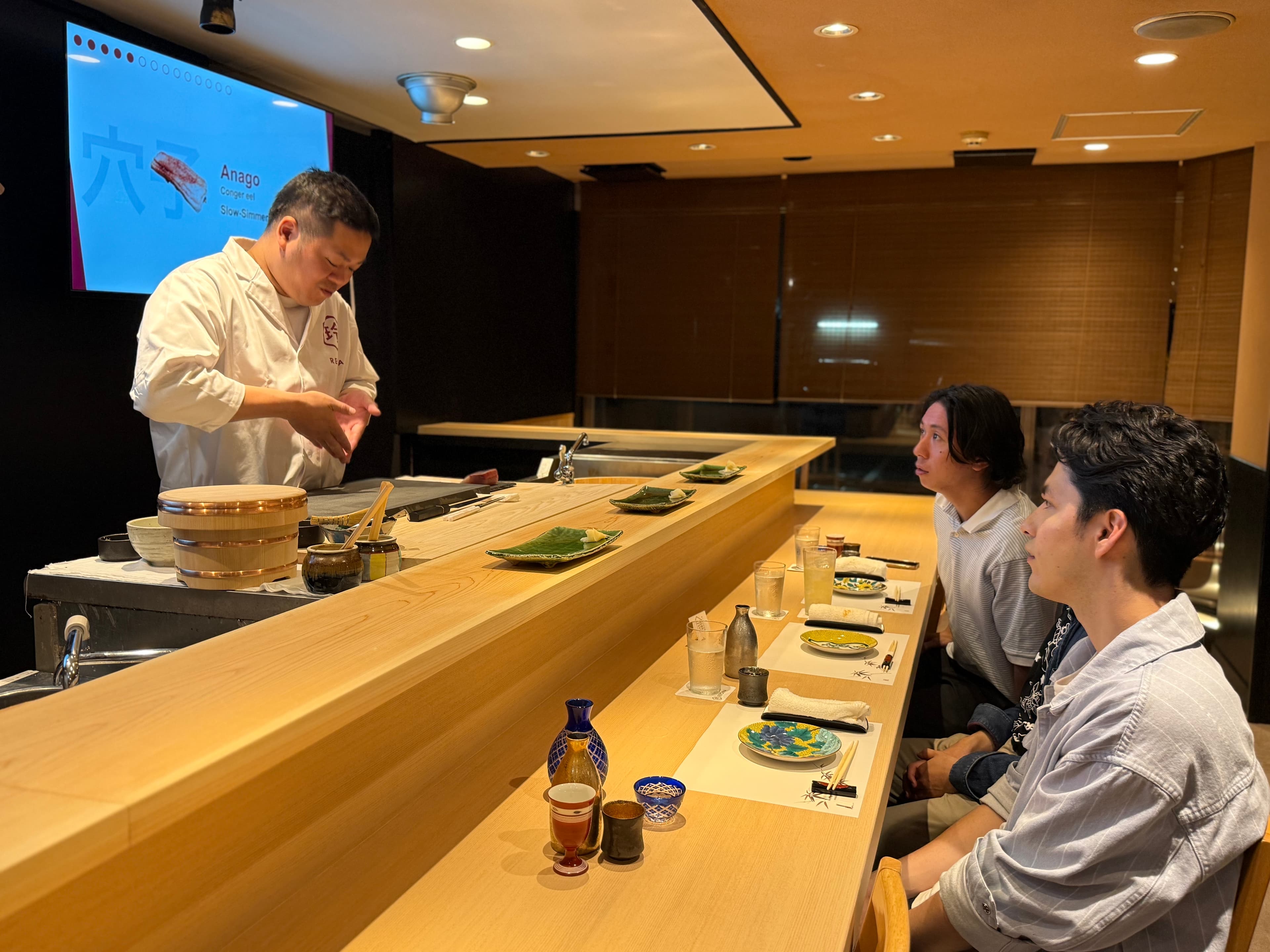

When people hear about REONA Sushi Tokyo, there is one thing that often surprises them.
"Only six seats?"
Tokyo is home to many sushi restaurants with far more seats than ours.
If we wanted to increase turnover, we could probably add more seats.
However, from the very beginning, we have been committed to keeping REONA small.
This is not simply because we like small restaurants.
It is because what we want to offer is more than just a meal.
At REONA, we want guests to experience what we call Understanding Sushi.
To create that experience, we felt it was essential to build an atmosphere that simply cannot be created with a large number of guests.
An Atmosphere That Cannot Be Created in a Large Restaurant
Omakase sushi has a unique atmosphere.
The aroma of the fish, the sound of the rice being prepared, the rhythm of the chef’s knife, the movements of the chef, and the conversations across the counter all come together to create a single experience. Especially in Edomae sushi, every piece is designed to be enjoyed at its best the moment it is served. Because of that, atmosphere is extremely important.
A chef prepares a piece of sushi, a guest receives it, and immediately brings it to their mouth. We did not want to lose the natural flow of that moment.
As the number of seats increases, service inevitably becomes more standardized. Of course, larger restaurants have their own strengths. There is energy, excitement, and a sense of scale. However, what REONA wanted to create was something much closer to a conversation.

We wanted to see each guest’s reactions. We wanted everyone at the counter to share the same atmosphere. We wanted to notice subtle changes in expression. When we thought about the distance needed to achieve that, six seats felt like the most natural answer.
Because the space is so intimate, guests can easily notice the chef’s subtle movements and attention to detail.
Occasionally, we accept up to eight guests when requested. In those situations, two chefs work together so the course does not become unnecessarily long. While this arrangement is necessary, it always feels different from our usual service.
With six guests, the experience feels personal. Guests can clearly follow the chef’s movements, conversations develop naturally, and the atmosphere feels calm and intentional.
With eight guests, however, the pace inevitably becomes faster. The craftsmanship is still there, but the feeling changes. The experience becomes more focused on execution and efficiency. Compared with our normal six seat operation, the sense of hand craftsmanship becomes less noticeable, and the experience can feel more like a process than a personal interaction.
The quality of the sushi remains the same, but it does not quite feel like REONA.
That realization reinforced our belief that six seats is not a limitation. It is an important part of the experience we want to create.
At REONA, it is not only the chefs who pay attention to our guests. Our navigators are constantly observing them as well.
Are they surprised by a fish they are trying for the first time? Are they feeling a little nervous? Do they look like they have a question they want to ask? Or are they the type of guest who prefers to quietly focus on the food?
We adjust the amount of conversation and the depth of our explanations based on the atmosphere at the counter.
Many international guests arrive feeling quite nervous.
They worry that luxury sushi restaurants are places where they need to remain quiet. They wonder whether asking questions might be considered rude or disruptive.
Some guests are visibly tense from the moment they sit down.
One thing we often hear from travelers is that Japan feels refined, sophisticated, and highly organized. While this is usually meant as a compliment, it can also become a source of pressure once they become participants rather than observers.
Many guests begin to wonder whether they are behaving correctly within Japanese culture.
Am I doing this right? Is it okay to talk? Am I making too much noise? What if I accidentally drop my chopsticks? When should I take a drink?
Questions like these are surprisingly common.
People often admire Japanese culture from the outside. But when they suddenly find themselves sitting at a sushi counter in Tokyo, surrounded by customs they do not fully understand, that admiration can sometimes turn into anxiety.
Because we only have six seats, we can notice those moments.
We can see when someone looks hesitant to ask a question. We can tell when someone seems worried about making a mistake. We can sense when a guest is trying very hard to follow the unspoken rules of a culture that is not their own.
That allows us to naturally say things like, “Please feel free to ask us anything.”
In turn, guests begin to relax.

They realize that this is a place where they are allowed to ask questions and be themselves.
We often see guests who are very quiet at the beginning of the course gradually become more engaged as the experience continues.
"Why don't we add soy sauce ourselves?"
"What exactly is Edomae sushi?"
"Why is this fish prepared this way?"
Questions begin to flow naturally.
Those moments are some of our favorites.
Because they show that a guest has moved beyond simply eating sushi and has started to engage with the culture behind it.
Rather than focusing on serving as many people as possible, we want to pay attention to each guest's emotions and how their experience develops throughout the course.
That philosophy is one of the reasons REONA is built around six seats.
At REONA, we place great importance on the idea of Understanding Sushi.
We believe that an experience becomes much deeper when guests understand not only what they are eating, but also why it is prepared that way.
One of our navigators, Kamei, often talks about something he learned while working at a five star luxury hotel.
He noticed that guests who left with the highest levels of satisfaction often had one thing in common.
They received detailed explanations about their food.
Instead of simply presenting a dish and naming it, staff would explain the techniques behind it, where the ingredients came from, why certain flavors were chosen, or the story behind a particular product. Guests who were interested in those explanations often enjoyed the experience on a much deeper level.
A dish became more than a dish.
It became a story.
It became something memorable.
We have found the same thing to be true at REONA.
Take kohada, for example.
For many international guests, it is not an immediately impressive fish. In fact, some people initially find it rather plain.
However, when they learn why kohada is considered one of the defining fish of Edomae sushi, why it is cured with vinegar, and why it has remained a traditional sushi topping for generations despite rarely being eaten outside of sushi, their perspective often changes.
At that point, they are no longer simply tasting a fish.
They are experiencing a part of Japanese food culture.
The same applies to techniques such as kombu-jime and zuke.
Once guests understand why these techniques were developed and how they became part of Edomae sushi, the experience becomes richer and more meaningful.
At the same time, these explanations cannot be one sided.
We need to understand whether the guest is interested, how much they already know, and what has surprised them.
A meaningful explanation depends on understanding the person sitting in front of us.
In other words, the experience of understanding sushi is completed through conversation.
That is why REONA has navigators.
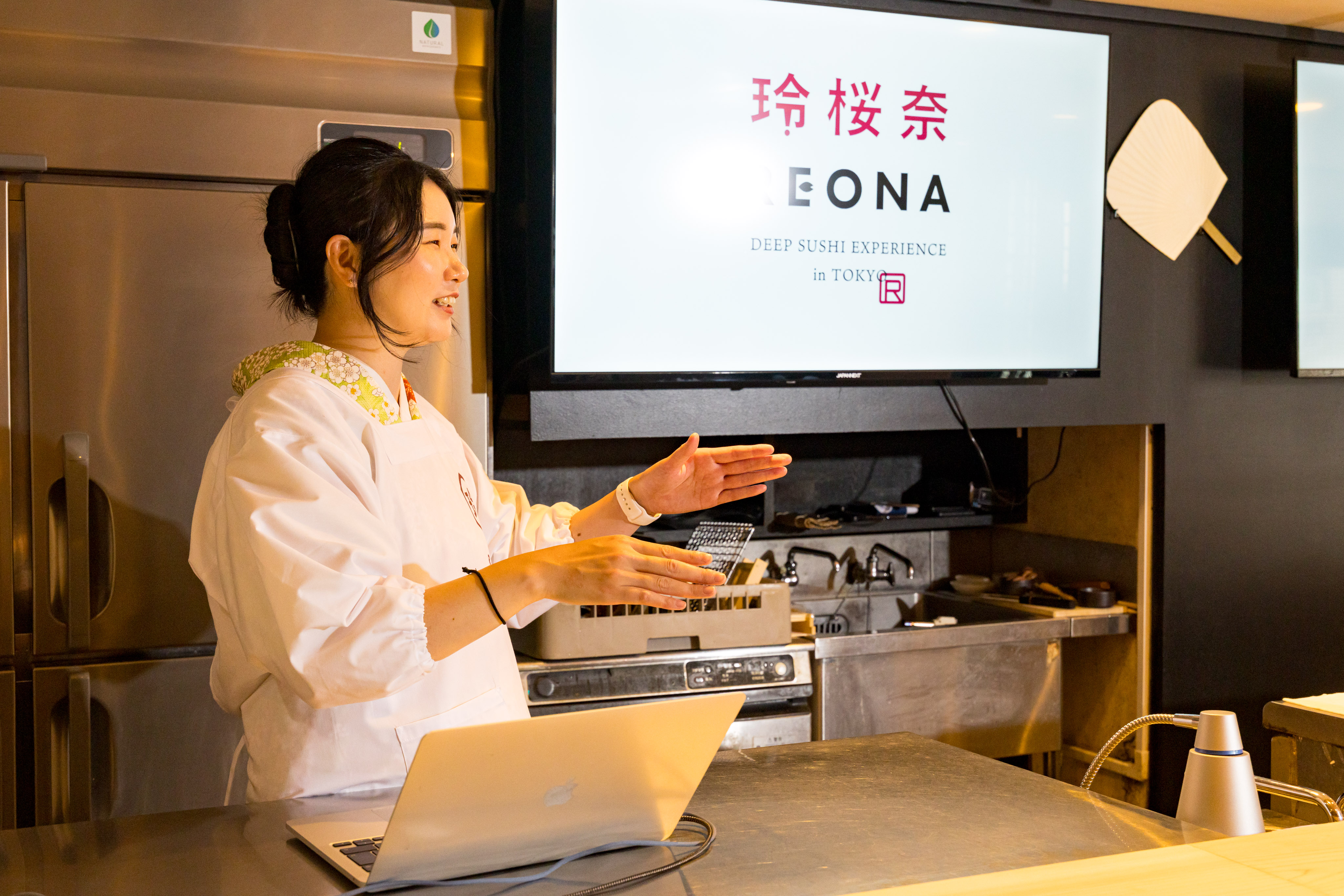
Their role is not simply to speak English. Their role is to translate the appeal of sushi itself while paying attention to each guest's cultural background, interests, and reactions.
Every guest is different.
Some want detailed explanations about fish and sourcing. Others are interested in Japanese history. Some are fascinated by knife techniques. Others simply want to understand why a particular piece tastes the way it does.
The role of a navigator is to find those points of curiosity and help guests connect with the culture behind the food.
And in order for those conversations to happen naturally, we believe the distance created by six seats is essential.
Most of the guests who visit REONA travel to Japan from overseas.
They come from the United States, Europe, Australia, Singapore, the Middle East, and many other parts of the world.
Their cultures are different, and so are their expectations when it comes to dining.
Some guests value a quiet atmosphere. Others enjoy conversation.
Some prefer to eat at a faster pace, while others like to take their time and savor each piece of sushi.
We want to create a space where all of them can enjoy Japanese culture comfortably.
That is why we think not only about the sushi itself, but also about the environment in which it is served.
The distance across the counter.
How easily conversations can begin.
How voices carry through the space.
The atmosphere shared among the guests.
All of these elements are part of the REONA experience.
Because most of our guests are travelers, we often think of ourselves as being part of the tourism industry as well as the restaurant industry.
For many people, an omakase experience is not just another meal. It is one of the highlights of their trip to Japan.
Some guests visit us during their honeymoon.
Others come to celebrate a birthday or anniversary.
Some join us as part of a family vacation.
Others have dreamed of experiencing authentic Edomae sushi for years before finally sitting at our counter.
We never forget that we are often becoming part of an important memory.
That is why we believe the space itself matters.
People sometimes ask us,
"Why don't you add more seats?"
For now, our answer remains the same.
We want to protect these six seats.
Because this distance creates a kind of experience that would be difficult to recreate in a larger space.
Because this size allows us to preserve a particular atmosphere.
Because it gives us the ability to truly see our guests, listen to them, and respond to them as individuals.
We do not know whether REONA will always remain a six seat restaurant forever.
What we do know is that, today, six seats allow us to create the kind of experience we believe in.
An experience built on conversation.
An experience built on understanding.
An experience built on genuine human connection.
And within this small counter, we hope to continue sharing Japanese culture with guests from around the world, one conversation and one piece of sushi at a time.
That is the design philosophy behind REONA Sushi Tokyo.