
Please note: Reservations are required; walk-ins cannot be accommodated.
Please note: Reservations are required.
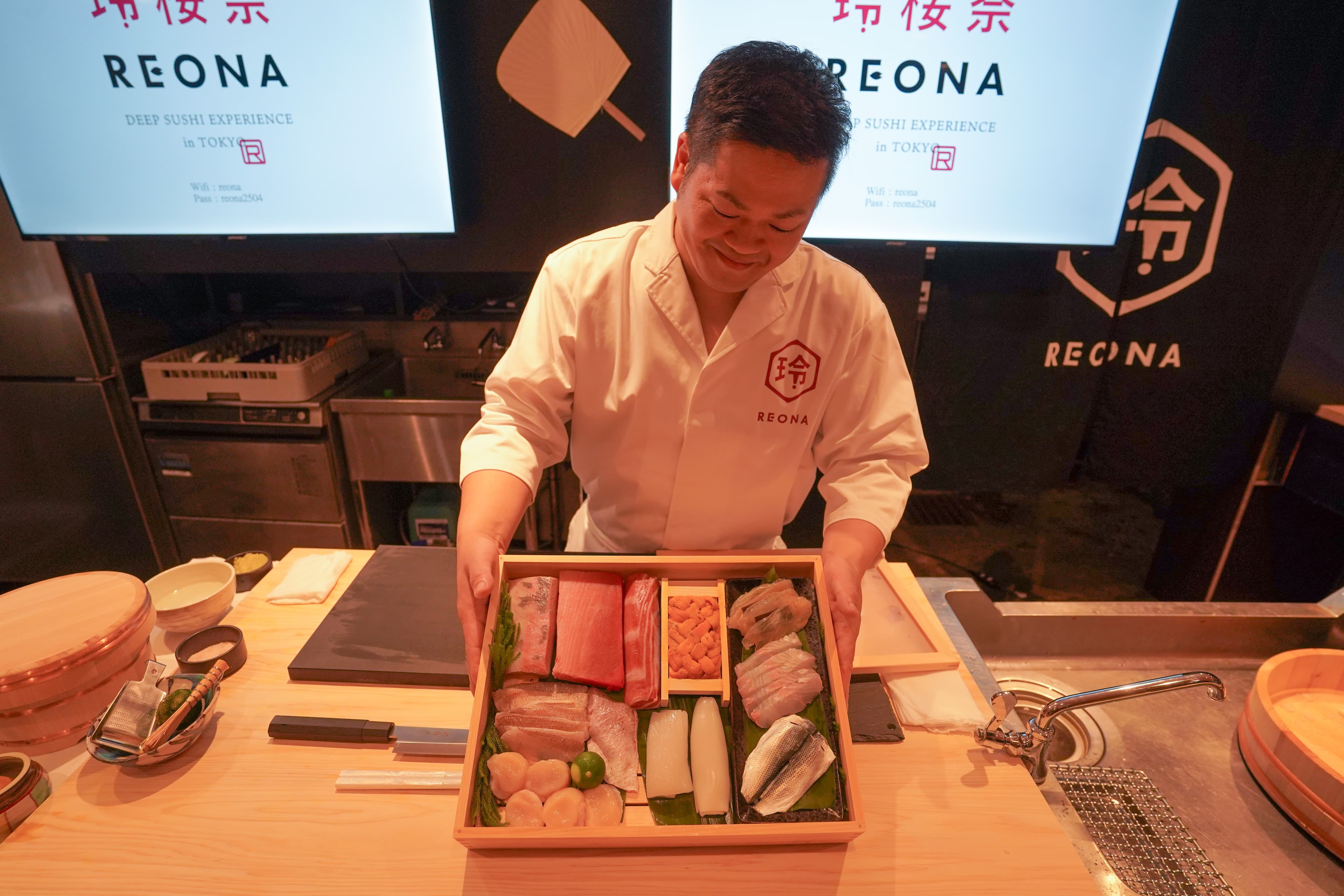

If you’re visiting Tokyo and thinking, “If I’m going all the way to Japan, I want to try authentic omakase sushi,” you’re probably not alone.
At the same time, I get all kinds of questions from people who are booking omakase sushi for the first time.
“What should I wear?”
“How long does the meal take?”
“What kind of sushi will I get?”
“Do I put the soy sauce on myself?”
“Do they speak English?”
“Can I bring my children?”
I guide guests from overseas every day, and even after they arrive, I get all kinds of questions.
“Is it true that you can eat sushi with your hands?”
“Then when should I use chopsticks?”
“Why are the chopsticks placed here?”
“Can I adjust the amount of wasabi?”
“When should I eat the gari?”
These may be things that Japanese people generally have a sense of, even without thinking about them too much.
But for someone visiting Tokyo from overseas, sitting at a traditional sushi counter for the first time can feel a little intimidating.
So, in this article, I’ll go over some things you should know before booking an omakase sushi experience in Tokyo.
The first thing I recommend checking is not to make your decision based on the word “omakase” alone.
Even when two restaurants both offer omakase sushi, the price, number of pieces, length of the meal, atmosphere, and reservation policies can be very different.

First, check the price.
Even if a restaurant lists a price “per person,” service charges, tax, or drinks may be charged separately.
Some restaurants serve around 10 pieces of nigiri, while others include several appetizers and cooked dishes in addition to the sushi.
Some places serve close to 20 pieces.
Honestly, that can feel like a lot of food.
I’ve had overseas guests tell me, “I didn’t expect there to be this much food!”
So rather than looking only at the course price, check what is actually included and how much you can expect to pay in total.
Another important thing to check is how the restaurant handles allergies and dietary restrictions.
With omakase, it may be difficult to simply ask the restaurant after booking to leave out certain ingredients on the day.
This can be especially important when cooked dishes or other small dishes are included. Ingredients that are familiar in Japan may be completely new to someone visiting from overseas.
For example, during the summer, you may come across junzai, a Japanese ingredient with a slippery, almost gelatinous texture.
At REONA, we also ask about allergies and dietary restrictions before the reservation.
For guests from overseas, there are cases where we need to go into more detail than expected about ingredient names or seasonings that may not be familiar to them.
So if you have any concerns, check with the restaurant before making your reservation. This includes not only allergies, but also religious dietary restrictions, vegetarian diets, gluten-free requirements, and other dietary needs.
When choosing a restaurant, think not only about the price, but also about what kind of time you want to spend there.

For example, even if two omakase sushi restaurants are in the same ¥20,000 or ¥30,000 price range, they can offer very different experiences.
Is it counter seating or table seating?
How close are you to the chef?
Is English available?
Can you take photos or videos during the meal?
Is it the kind of atmosphere where you can enjoy talking during the meal?
These differences can actually make a surprisingly big difference once you’re there.
For international visitors to Tokyo, whether a restaurant offers English support can be especially important.
But there’s something I think is worth paying attention to here.
“English support” and “being able to understand sushi in English” are not necessarily the same thing.
I speak English with overseas guests every day, and through my experience in customer service, I’ve realized that simply being able to communicate in English does not solve everything.
Some restaurants may allow you to make reservations and place orders in English.
Others may also explain how to eat the sushi, what kind of fish you are eating, and the background of Edomae sushi in English.
At REONA, a navigator joins the chef at the counter and takes care of communication with our overseas guests.
Answering questions about sushi and helping connect guests with the chef are also part of the navigator’s job.
If your goal is to experience Japanese sushi culture more deeply, it can be worth checking how much explanation and guidance the restaurant actually provides.
That can make it easier to find a restaurant that suits what you are looking for.
There’s something I really want first-time omakase guests to know.
A sushi counter is not simply a place where you sit down and eat food.
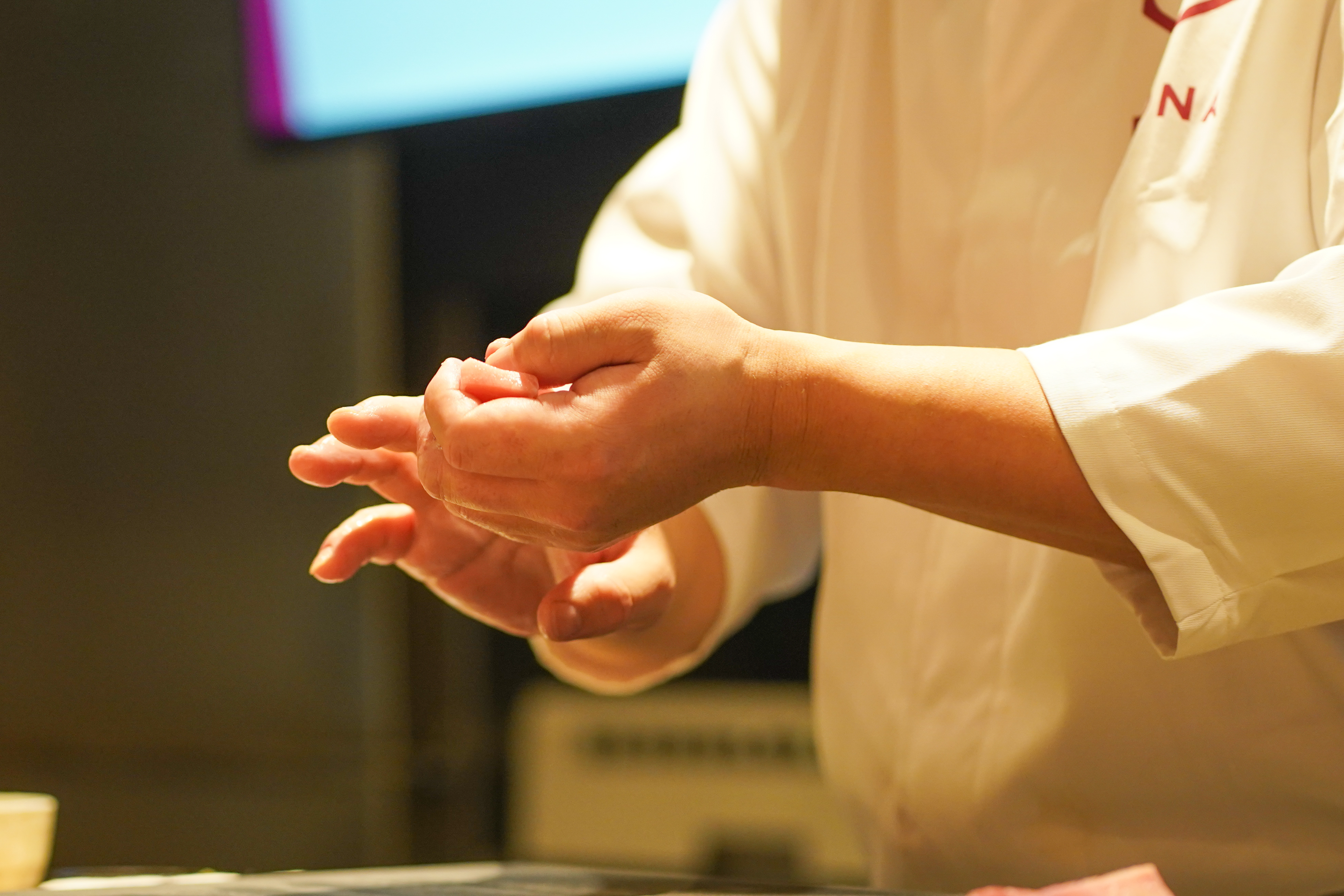
You watch the chef cut the fish right in front of you, shape the shari, and make each piece of sushi one at a time.
Then you eat each piece while it is freshly made.
That is a big part of what makes a sushi counter special.
Personally, I think sitting at a sushi counter is a cultural experience in itself.
With Edomae sushi, the fish is not simply sliced and placed on top of rice. There are many different preparation techniques, such as marinating the fish in soy sauce, curing it with vinegar, simmering it, or searing it.
Because the chef has prepared each piece to be eaten as it is, I generally recommend eating it as soon as it is served.
One thing I see overseas guests do quite often is wait until everyone sitting at the counter has received their sushi before they start eating.
I understand this because I lived in Canada, and I know that in the US and Canada, it is common to wait until everyone has received their food before starting to eat.
Starting before everyone else can feel rude.
In fact, guests at REONA sometimes ask me,
“Should I wait until everyone has their sushi?”
I completely understand why they ask.
But especially when it comes to Edomae sushi, the answer is actually no.
Once your sushi is served, you can go ahead and eat it. You don’t need to wait for everyone else to receive theirs.

You have enough time to take a photo, of course, but sushi is generally meant to be eaten when it is served, when it is at its best.
So try to eat it relatively soon.
Whether you use soy sauce, eat with your hands, or use chopsticks can also vary from restaurant to restaurant.
And you really don’t need to worry about asking, “Is it okay to ask this?”
Rather than trying to figure everything out by watching the people around you, asking the staff can actually help you enjoy the sushi more.
After reading all this, you might be thinking,
“Okay, high-end sushi still sounds pretty intimidating…”
But there are also things that are more fun precisely because it’s your first time.
You don’t need to have any prior knowledge about sushi.
If you don’t know something, just ask.
“What kind of fish is this?”
“How should I eat this?”
“What has been done to this piece of sushi?”
These are not embarrassing questions at all.
Honestly, even though I now talk about sushi as a navigator, I didn’t have nearly as much knowledge about sushi before I started working at REONA.
I’m Japanese, but I had to learn everything from scratch.

That’s exactly why I don’t think you should feel embarrassed about going to an omakase restaurant just because you don’t know much about sushi.
Actually, before the course starts at REONA, I half-jokingly and half-seriously tell our guests,
“By the time you leave, you’ll know more about sushi than the average Japanese person.”
And honestly, I mean it.
At REONA, I sometimes see guests who were a little nervous at first become more and more curious as the meal goes on.
They may be quiet during the first piece.
Then suddenly they start asking things like,
“How is this different from the fish we just had?”
“Why do people in Japan eat it this way?”
I don’t think it’s necessarily because they suddenly learned a lot about sushi.
I think it’s because they realized, “Oh, I’m allowed to ask questions.”
That is probably one of my favorite moments as a navigator.
When a guest who was quiet at the beginning starts asking more and more questions, it tells me they’ve reached the point where they feel comfortable saying, “I don’t know, but I want to ask.”
When people hear “omakase sushi,” some worry that there might be a dress code.
Of course, the rules vary from restaurant to restaurant, but at a typical sushi counter, you generally don’t need to wear a suit or a dress.
If you’re traveling, clean and presentable clothes are usually perfectly fine.
There is one thing I would strongly recommend avoiding, though.
Strong perfume.
Actually, it can be a pretty big problem, so please don’t wear perfume when you go to a sushi restaurant. The same goes for strongly scented fabric softener.
At a sushi counter, you sit quite close to the other guests, and the space is also somewhere you can appreciate the delicate aromas of the fish, vinegar, rice, and other ingredients.
At REONA, we don’t have a dress code, partly because almost all of our guests are international travelers.
Japanese summers can be extremely hot, and it’s easy to imagine how uncomfortable it would be to dress up and then spend the whole meal feeling overheated.
And getting sick because of that and having it ruin your trip would be the last thing we want.
So unless you’re wearing something extremely revealing or otherwise inappropriate, we don’t have a specific dress code.
Wear whatever makes you feel most comfortable that day.
When you’re traveling, it’s tempting to pack as much as possible into each day.
But on the day you have an omakase reservation, I recommend leaving yourself some extra time.
With omakase, all the food is not served at once.
The chef serves each piece one at a time, combining sushi and other dishes and adjusting the pace throughout the meal.

So it’s a little different from a meal where you eat everything in 30 minutes and immediately move on to the next activity.
The timing varies quite a bit depending on the restaurant, but some counter-style omakase meals can take anywhere from around 1.5 to 2.5 hours.
At REONA, our Signature Course takes around two hours, including 14 pieces of sushi and other dishes. If the pace is slower, it can take around two and a half hours.
Especially if you have sightseeing, shopping, or a trip to the airport planned after your meal, make sure you leave yourself enough time when making your reservation.
Instead of thinking, “I’ll finish eating and immediately move on to the next thing,” think of it as, “This is the time I’m setting aside to enjoy sushi.”
That small change in mindset can make a difference in how you experience your time at the counter.
Finally, there’s something I’d like to tell anyone looking for omakase sushi in Tokyo.
When choosing a restaurant, don’t only think about what you want to eat.
Think about what kind of experience you want to have.
Maybe you want to eat authentic Edomae sushi.
Maybe you want to watch a sushi chef work up close.
Maybe you want to learn about Japanese sushi culture.
Maybe you want to talk with the chef.
Maybe you simply want a special meal during your trip.
Depending on what you’re looking for, a different restaurant may be the right fit.
At REONA Sushi Tokyo, we have a navigator who guides our overseas guests in English so they can enjoy Japanese Edomae sushi and learn more about Japanese food culture.
What we care about is not only “eating,” but also “understanding.”

Learning the name of the fish.
Learning how it has been prepared.
Learning why it is served at that particular moment.
Sometimes, knowing just a little more can make a single piece of sushi much more memorable.
Tokyo has so many different options, from conveyor belt sushi and casual sushi restaurants to omakase restaurants where a chef makes each piece right in front of you.
That’s why I don’t think choosing the most expensive restaurant is necessarily the answer.
Think about what kind of sushi experience you want to have in Tokyo.
That may be the best way to find a restaurant that is right for you.
And once your reservation is made, you really don’t need to be nervous.
Give yourself plenty of time, arrive hungry, and if there’s something you’re curious about, just ask.
That alone can turn an omakase sushi experience into a special memory from your trip to Tokyo.