
Please note: Reservations are required; walk-ins cannot be accommodated.
Please note: Reservations are required.


“Why did you leave a five-star hotel to work at such a small sushi restaurant?”
That is a question I get from time to time at REONA.
It is true. I used to work at a five-star hotel.
Every day, I welcomed VIPs and guests from all over the world and helped them experience Japanese hospitality. I found the work very rewarding.
Even so, I chose REONA, a small sushi restaurant with just six seats.
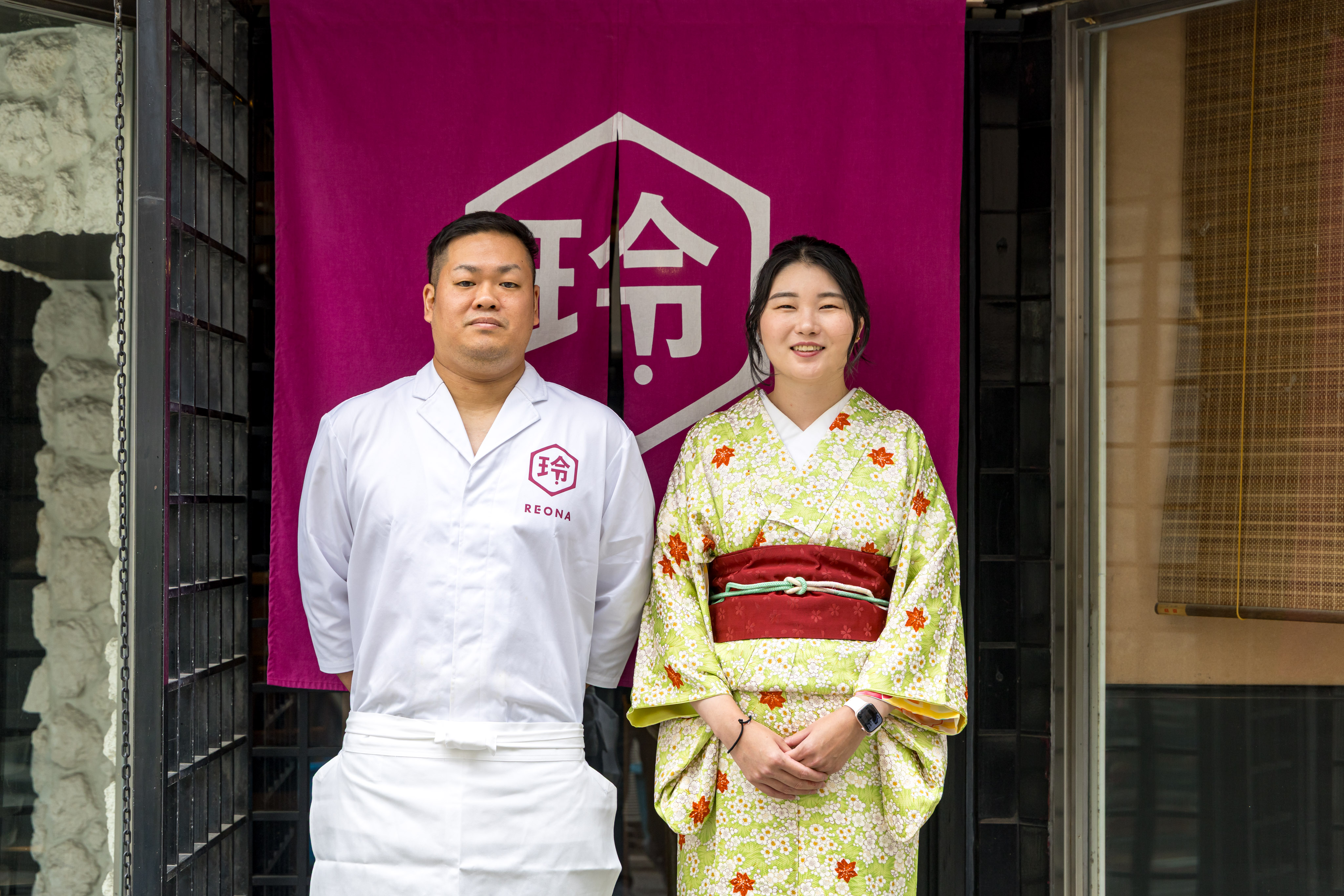
Today, I would like to share a little about why.
At a hotel, waiting until a guest asks for something is often too late.
If someone looks cold, offer them a blanket.
If they look unsure of where to go, approach them.
If they seem to be having trouble, step in before they have to ask.
Sometimes, even the angle at which a guest holds a teapot can tell you it is time to ask if they would like another drink.
I learned this kind of “reading the guest” hospitality very thoroughly at the hotel.
About half of our guests came from overseas, so I also had many opportunities to introduce people to Japan.
In spring, I would recommend places to see cherry blossoms.
In summer, I would tell guests about festivals happening that weekend.
But over time, I started to notice something.
Even when a guest stays at a hotel for several days, there are surprisingly few opportunities to have a long conversation with them.
I experienced both the bell desk and the restaurant side of the hotel.
The bell desk is the face of a hotel. Bell staff are often the first people guests meet, so you have to make a very good first impression.
But for many guests, the bell desk is a place they pass through in a matter of moments.
The main time we had a chance to stay involved with a guest was when we were looking after their luggage, and it was difficult to build a deeper connection beyond that.
I also worked at a restaurant that was open from breakfast through dinner.
Of course, guests were there to eat. Even if they enjoyed chatting with us, the conversation they had with the people they came with would naturally be the main part of their meal.
In both roles, I found it difficult to have deeper conversations and really connect with individual guests.
I remember one particular experience from my time at the bell desk.
At the time, part of my job was escorting guests from the nearest station to the hotel while helping with their luggage.
One day, a guest told me that he was from a town near the place where I had lived in Canada during my working holiday.
We immediately had something to talk about, and the conversation started to get interesting.
And then we arrived at the hotel.
The walk from the station to the hotel took about five minutes, even at a relaxed pace.
We had only five minutes to talk, and there was so much more I wanted to share with him, from what was happening in Japan at the time to ideas for exploring Tokyo.
But we simply ran out of time.
We had just started getting along. We had found something we had in common.
And then it was over.
I remember thinking how much of a shame that was.
I started wondering whether there was a job where I could spend more time really getting to know each guest.
That thought gradually became stronger.
There is something I have noticed in the conversations I have had with overseas guests.
“Everything was delicious.”
Of course, that is always wonderful to hear.
But the guests who seem to leave with the strongest memories often talk about something else too.
“Why do we have gari with sushi? And why is some of it pink and some of it white?”
“What do you mean by different cuts of tuna? Aren’t they different kinds of tuna?”
“Wait, wasabi is not from a tube?”
There is something special about the moment someone discovers something they did not know before.
You can see it on their face.

For Japanese people, many of these things are completely ordinary.
For visitors from overseas, they can be one surprise after another.
Because we keep the conversation open, the conversation can also move beyond sushi.
“What is something I can experience in Tokyo that I can only do right now?”
“Is there somewhere my children would really enjoy?”
“You’re from Kansai? Do you have any recommendations for Osaka or Kyoto?”
Travel is not just about eating or seeing places.
I gradually came to feel that learning something about Japan is part of what makes the trip special.
The concept behind REONA is:
“Understanding Sushi”
We do not want guests to simply enjoy good sushi.
We want them to understand a little more about what they are eating.
Why did Edomae sushi develop?
Why is wasabi used?
Why do sushi chefs care so much about their knives?
Once you know some of the background, the same piece of sushi can be experienced differently.
When I read the reviews our guests leave, many of them mention how much they enjoyed the food, of course. But many also talk about our hospitality and how much they learned about sushi.
Guests often tell us things like:
“I learned so much about sushi.”
“It was an excellent cultural experience.”
As a Navigator, my role is to connect our guests with the chef.
I am not there simply to explain the food.
I try to create an atmosphere where guests feel comfortable asking questions, help explain differences between Japanese and overseas cultures when they come up, and sometimes just have a casual conversation.
Before long, guests who had never met each other are laughing together, and the whole counter starts to feel like one shared space.

There have been birthdays where we brought out a cake, everyone at the counter sang “Happy Birthday,” and the whole group celebrated together.
There was another time when we discovered that one of the guests was a legendary ballet dancer. Everyone ended up looking through photos and videos from that person’s career, and later, we even exchanged Instagram accounts.
There have also been evenings when guests loved the sake so much that they said, “One more round!”
We poured another drink for each of them, they gave me one too, and before long, both the chef and I were sitting at the counter chatting with them.
When I feel that I have done a good job as a Navigator, it is not necessarily because I gave a perfect explanation.
It is when I picked up on something from what a guest was telling me and found a way to keep the conversation going.
It is also when I notice something about what they are wearing or carrying and use that as a starting point for a conversation, and the whole thing takes off from there.
Those are the moments when I feel that we created a really good experience.
Every time that happens, I think:
“This is less like a restaurant and more like an experience.”
Japan has incredible food.
But I do not think the appeal of Japan comes from food alone.
It is the skill of the craftspeople.
The seasons.
The tableware.
History.
Culture.
Japanese people themselves.
Japanese values.
Hospitality.
I think all of these things come together to create what we experience as Japan.
At REONA, we want to use sushi as a starting point and help our guests become a little more interested in Japan.
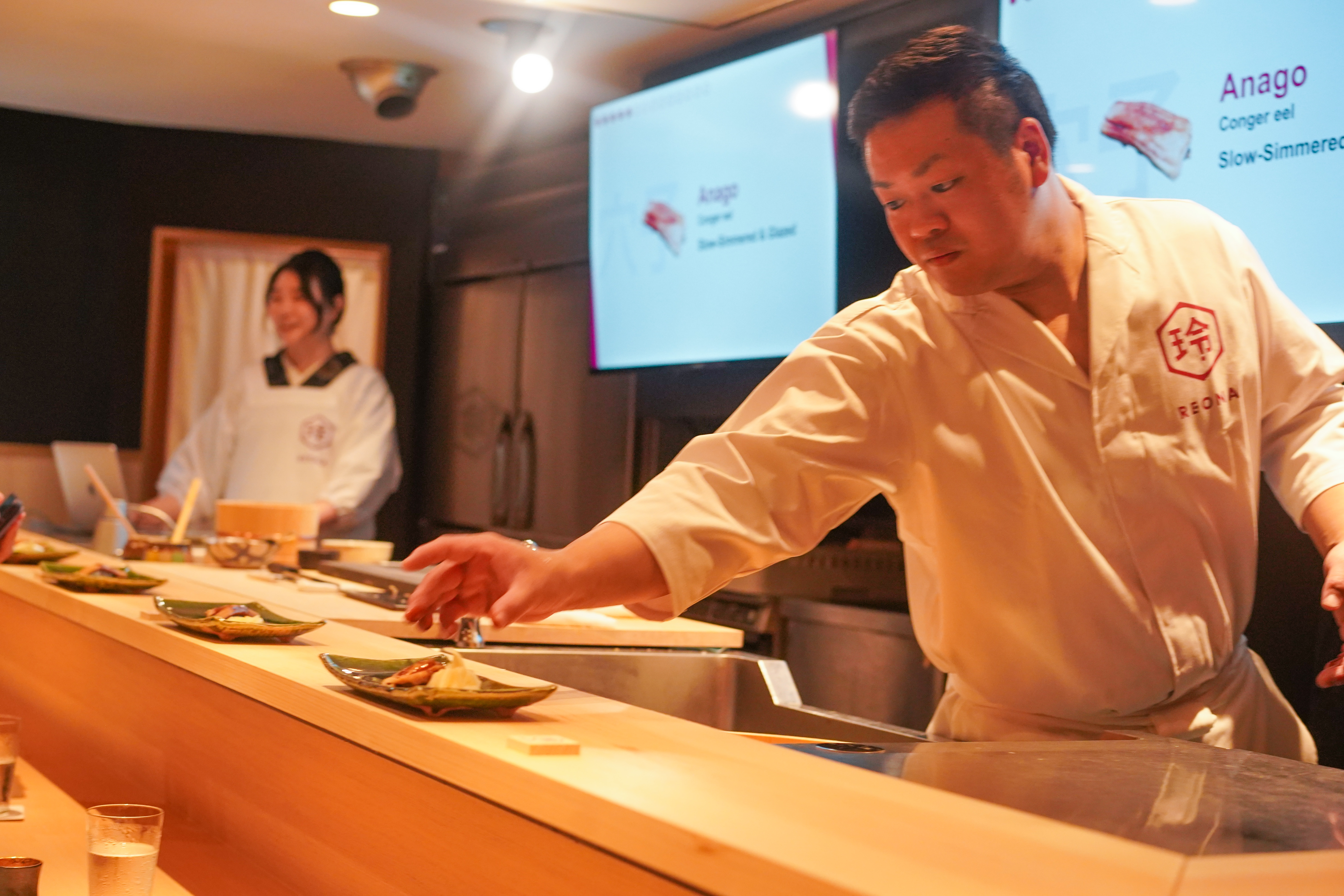
Sometimes we hear:
“That was the most memorable meal of our trip to Japan.”
We also often hear things like:
“This was the highlight of our Japan trip.”
“More than dinner. It was a cultural experience.”
Of course, some of that comes from the sushi itself.
But I also believe those comments come from the feeling that they were able to learn something about Japan while they were here.
At the hotel, things often ended with,
“Thank you very much.”
And of course, I was always happy to hear that.
But at REONA, I sometimes hear things like:
“Next time, I’m bringing my parents.”
“When my children are older, we’ll come back.”
“Can I get the chef’s autograph?”
“I know people in Japan don’t usually do this, but I want to give you a hug!”
“I have friends coming to Japan next, so I’m going to tell them about REONA.”
Those words mean something different from simply being thanked for good service.

When I hear them, I feel:
“We didn’t just serve them a meal. We created a memory.”
The hospitality I learned at a five-star hotel, and the conversations we have at REONA, are both there for the same reason.
So that when guests finish their meal, they leave feeling just a little more connected to Japan.
That is why I work at REONA.