
Please note: Reservations are required; walk-ins cannot be accommodated.
Please note: Reservations are required.


“Sushi was delicious.”
Of course, there is no better compliment for us than hearing that.
REONA Sushi Tokyo currently has 184 reviews on Google, with an average rating of 4.9.
On Tripadvisor, we have another 68 reviews, also with a 4.9 rating.
That brings us to 252 reviews in total, as of August 27, 2026.
Considering that we have only been open for about a year and four months, we are truly grateful for these numbers.
Of course, one reason is that our chefs carefully prepare and serve each piece of sushi.
But when I read through the reviews our guests have left us, I notice something.
They are not only writing about how good the sushi was.
“A truly memorable dinner.”
“Absolutely amazing and perfect sushi omakase experience for my family, with children ages 5-15.. the sushi was the best I have ever had and I am a big foody.”
“It was by far the best sushi experience I ever had!”
“The staff were friendly, inviting and open to casual conversation.”
“Learned a lot about sushi and preparation behind it.”
“Such a great experience especially with children!”
“This is the most friendly experience here in Tokyo!”
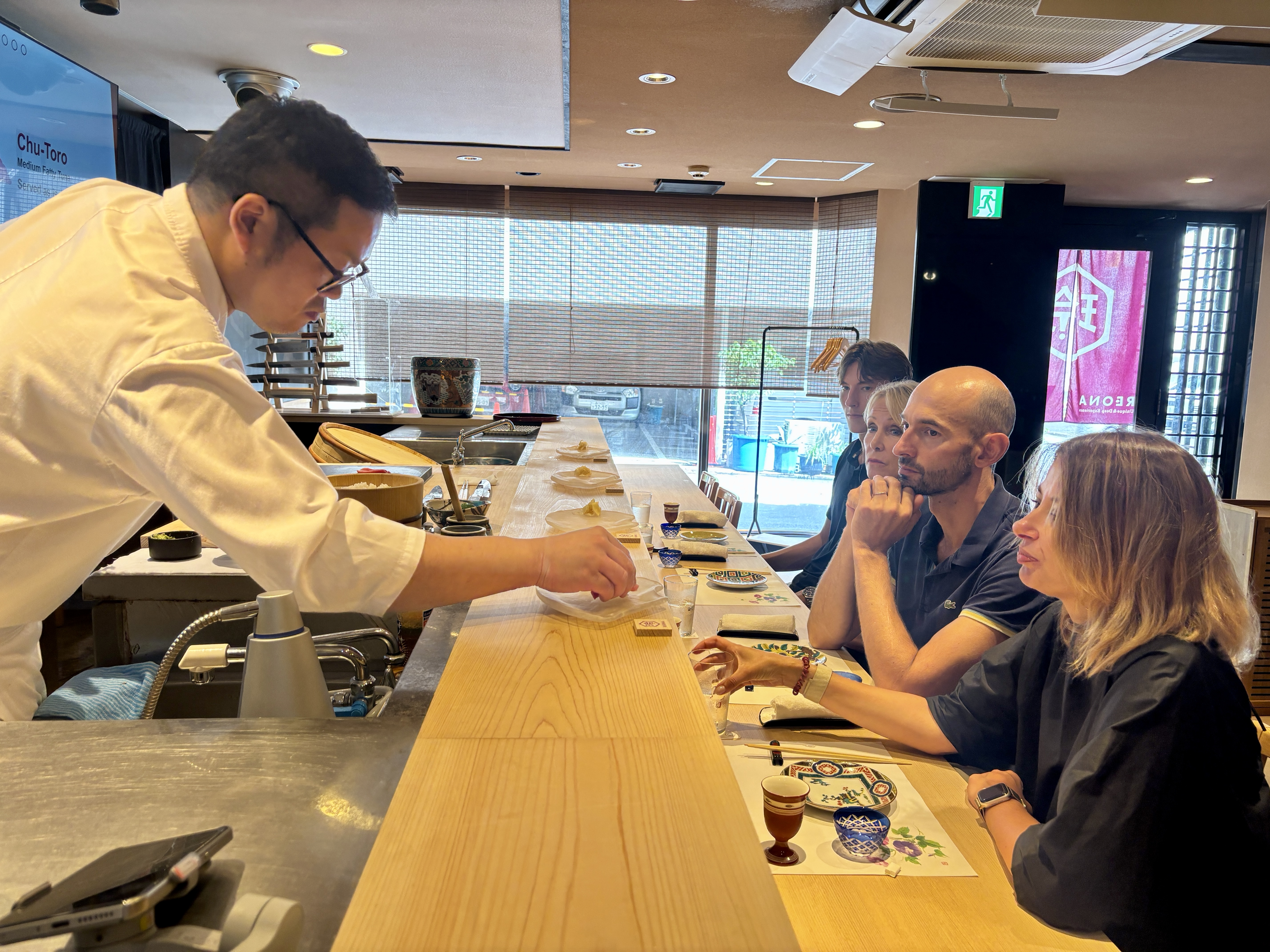
Our guests talk not only about the food itself, but also about conversations with our staff, the fun of learning about sushi, and the time they spent with their families.
We believe these are all part of what supports REONA’s high ratings.
In this article, I want to share a little more about why guests give REONA such high ratings, and what we believe is behind those reviews.
For a sushi restaurant, serving good food is the starting point.
No matter how good the service is, if guests are not satisfied with the sushi itself, it is difficult for them to leave thinking, “I would like to come back.”
At REONA, we value traditional Edomae sushi techniques while considering the condition of each fish, the season, and the balance with the shari, serving each piece one at a time.
But we do not believe that “serving delicious sushi” is where our job ends.
About 99% of REONA’s guests come from overseas to visit Japan.
For many of them, dining at REONA is not simply one dinner during their trip.
Their trip to Japan itself is a special experience, and they have chosen REONA as one part of that experience.
That is why we want to create a time when they feel, from the moment they walk through the door until they leave, “I’m glad we came here.”
One of the things we value most is allowing our guests to enjoy both eating and learning.
When someone has a question about a particular fish, we may explain not only what the fish is, but also why it has been prepared that way or why it is being served at that particular point in the course.
“Learned a lot about sushi and preparation behind it.”
Hearing words like this means a lot to us.
If a guest leaves having not only thought, “That sushi was delicious,” but also, “I understand a little more about sushi now,” we believe that is another part of what makes a Tokyo sushi experience at REONA meaningful.
At REONA, we place a lot of importance on communication with our international guests.

I speak with international guests almost every day, and there are many things that feel obvious to us as Japanese that may not be obvious to someone visiting Japan from overseas.
“What is this?”
“Where is this fish from?”
“Is there a reason it is served in this order?”
“Can children eat this?”
“I have an allergy. Is that okay?”
“There is something I really cannot eat. Would it be rude if I left it?”
“Why are you pairing this sake with the sushi at this particular point?”
We sometimes receive questions like these even before our guests arrive at the restaurant.
Sometimes the questions are about Japanese culture and the thinking behind it, such as,
“Why are the chopsticks placed this way in Japan?”
That is why I do not think simply being able to speak English is enough.
What matters is understanding what the person actually wants to know.
We try to think not only about the question itself, but also about what is behind it and what they are really trying to understand.
Simply translating sushi terminology into English does not always make it easy to understand.
Something that is obvious to a sushi chef may be much more enjoyable for an international guest experiencing authentic Japanese sushi for the first time if we explain the background as well.
On the other hand, some guests would rather enjoy the food quietly than listen to a lot of explanations.
Everyone is looking for something different.
That is why, rather than simply “explaining” in English, we focus on having a conversation and finding the right level of interaction for each guest.
“The staff were friendly, inviting and open to casual conversation.”
Some time ago, a Japanese guest brought a VIP guest from overseas to REONA.
The Japanese guest later told me,
“Your explanations are really good. I could tell that you weren't just translating. You were explaining things in the context of understanding the culture. It was clear that you understand both Japanese culture and overseas cultures.”
Those words have stayed with me ever since.
We are not doing one particular special thing just to receive good reviews.
If anything, we believe in the accumulation of small things we do every day.
For example, when someone contacts us before making a reservation and asks, “Is it okay to bring children?”
We do not simply reply, “Yes, that's fine.”
How old is the child?
Where will they be eating?
What kind of menu is available?
Are there any foods they do not like?
Do they need any special arrangements?
Depending on the situation, we may ask questions of our own.

The same applies to allergies and dietary restrictions.
We make sure to clearly explain what we can and cannot accommodate in advance.
Because we are a small restaurant, there are times when we simply cannot accommodate a particular request and have to turn a reservation down.
Even so, I believe it is much more important to be clear from the beginning than to simply say, “That's fine,” when we are not sure.
If guests are visiting us for a celebration, we may also provide information about our cake options.
For guests visiting Japan for the first time, we may explain how to get to the restaurant if the location is difficult to find.
We may also give advice on things like what to keep in mind when coming by taxi or what time they should arrive.
People in different countries can have slightly different expectations about reservation times, too.
When you think about it this way, there are actually quite a few things we can do even before a guest arrives.
And it is the same once they are here.
We help guests who have difficulty walking.
If it seems like the guests would enjoy some conversation, we may make a joke or ask a question ourselves.
There was even a time when two children started arguing, and we waited about 30 minutes until they had calmed down.
We notice when someone's glass is empty and ask if they would like another drink, or suggest another sake.
If we learn during a conversation where someone is planning to go the next day, we may talk a little about that destination, too.
The truth is, we do not follow exactly the same routine every day.
We look at the group we have that day and how the guests are doing, and make decisions as we go.

And we do not do these things just to get people to leave us a review.
We do them because if we can reduce even one source of uncertainty or worry for someone traveling in Japan, we believe they can enjoy their time at REONA that much more.
In fact, guests sometimes tell us, “You were so helpful even before we arrived.”
One guest once told me,
“Oh, you were the person I had been emailing! Your emails were so clear and thoughtful. They really helped me.”
Hearing things like that makes us very happy.
Because we do not believe a guest's experience begins the moment they walk through the restaurant door.
It starts when they are considering making a reservation.
When they are exchanging emails with us.
When they are looking up how to get to the restaurant on the day.
And even after they leave, while they continue traveling around Japan.
We believe all of those moments are part of the REONA experience.
What makes us happiest is not just hearing, “The food was delicious.”
It is hearing things like,
“I want to come back here next time I visit Japan.”
“Next time, I want to bring my family.”
“I’m going to recommend this place to my friends.”
For guests visiting Japan from overseas, their time at REONA may be a once-in-a-lifetime experience.
That is why we want to make that one meal really count.
We want guests to leave not only having enjoyed their sushi, but also with a little more interest in Japanese food culture.
We want REONA to become one of the memories they take home from their trip to Japan.
And we hope they leave thinking, “I really like Japan.”
“Such a great experience especially with children!”
“This is the most friendly experience here in Tokyo!”
We are truly happy whenever we receive comments like these.
One former guest even told us, about six months after their trip,
“I still talk with my family about our experience at REONA. We had such a great time that it has stayed with us.”
That really meant a lot to us.
And if, someday, they return to Japan and think,
“Oh, I remember that sushi we had in Tokyo. It was so good.”
“I think we should go back to REONA.”
There is nothing that would make us happier.
A 4.9 rating on Google is not just a number to us.
Behind that number are the words that each guest has taken the time to write.
Words about the food.
Words about conversations with our staff.
Words about learning something new about Japanese sushi.
Words about the time they spent with their families.
We want to value every one of those words and continue working toward becoming not just a restaurant with great sushi, but a place where guests can leave thinking,
“I’m really glad we came here during our trip to Japan.”
To everyone who is planning to visit REONA, and to everyone who has already visited us, we hope to see you again someday.